Introduction
You are not reading this because things are going well.
You are reading this because you walked into a situation where work gets approved because someone powerful wants it, priorities shift based on whoever had the last conversation with the CEO, and the portfolio — if you can call it that — is a collection of commitments made at different times by different people with different information and no shared picture of the whole.
Or you are about to walk into that situation. Or you have been in it for a while and you are trying to make sense of what to do next.
This guide is for you. Not for the organization that already has a mature governance model and wants to optimize it. Not for the theorist who wants to map EPMO frameworks across maturity dimensions. For the practitioner who is standing inside a running organization, being asked to build governance infrastructure while the work continues without waiting for it.
You are building and flying at the same time. This guide was written for that condition.
What This Is
Twelve steps. In order. Because the order matters.
Each step exists because the one before it created the conditions for it. You cannot prioritize work you have not inventoried. You cannot inventory work you have not seen. You cannot govern delivery if you never built a real tollgate — a structured decision point where work is formally approved, held, or stopped before it consumes delivery resources. You cannot measure value if you never defined what value was supposed to look like at intake.
The sequence is not arbitrary. Organizations that jump to Step 6 without Steps 1 through 5 in place produce prioritization theater — a scoring model that everyone games because there is no intake discipline to give it honest inputs. Organizations that build a tollgate without authorization discipline watch approved work sit idle because nobody confirmed the resources existed before the gate opened. Every shortcut has a downstream cost. The sequence protects you from those costs.
Each step includes the real patterns you will encounter, the things that will go wrong, and the single most important thing that determines whether the step works or fails. Each step ends with the artifacts — the tools you walk away with that you can use in the next meeting, with the next stakeholder, on the next decision.
This is not a maturity model to admire. It is a sequence to use.
Five Disciplines That Thread Through Everything
Five disciplines appear in every step of this guide. They are not steps themselves — they are lenses that apply differently depending on where you are in the sequence. At the end of each step you will find a section titled “Where the Disciplines Show Up” that identifies how each one applies at that specific point in the work.
Decision Discipline — Who decides, based on what evidence, with what authority, and what written record? This question is present from the first stakeholder interview through the last benefits review.
Change and Absorption — Can the organization adopt and sustain what this work requires? Change saturation — the point at which an organization’s people can no longer absorb new demands on top of what they are already managing — is a portfolio risk. It starts at intake and does not end at go-live. Intake design is a change-readiness question as much as a process question: the form that captures project scope should also capture who absorbs the change, how much change that group is already carrying, and who owns adoption. A governance model that approves investments without assessing absorption capacity is approving the delivery and ignoring the risk that what is delivered will not stick. This discipline shows up at four specific points in the sequence — Step 3 Intake, Step 7 Tollgate, Step 9 Health vs. Value, and Step 11 Benefits — shown together below.
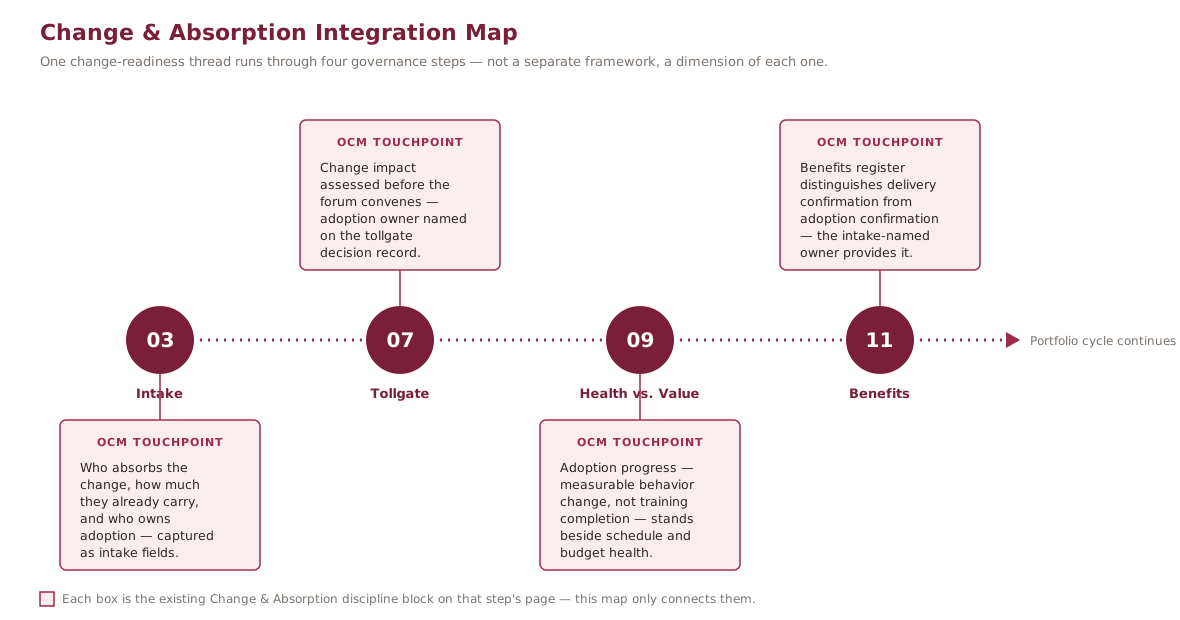
The four Change & Absorption touchpoints, shown together. Useful for briefing an executive on how this framework handles change management in a single conversation, rather than assembling it from four separate pages.
Enterprise Fit — Does this investment fit the organization’s architecture, risk posture, compliance requirements, data landscape, and operating reality? These are not technical questions. They are investment questions.
Evidence and Learning — What do we know, what are we assuming, and what changed as a result? The distinction between evidence and assumption runs through every artifact in this guide.
Political — Who controls what, whose coalition you need, and what you trade to get it. Every governance step produces winners and losers, surfaces work that someone wants invisible, or requires authority the EPMO has not yet earned. This guide names political realities openly throughout — not because governance is inherently political, but because a practitioner who cannot navigate power cannot build anything that lasts. The political discipline is not about maneuvering. It is about knowing what the room actually is before you try to change it.
What This Is Not
This is not about building a PMO that impresses people. Impressive PMOs that do not improve decisions are overhead. Organizations get rid of overhead.
This is not about creating process for its own sake. Every control in this guide exists because something specific breaks without it. When the control is heavier than the problem it solves, the control is wrong.
This is not theoretical. Every pattern named in these pages has been observed in real organizations — federal agencies, financial institutions, global enterprises, state governments — where the stakes were high enough that getting it wrong had real consequences. Congressional oversight. Millions of customers. Regulatory deadlines that could not move. The discipline that worked in those environments was not the most sophisticated available. It was the most consistently applied.
This guide holds to one standard throughout: if someone cannot use it on Monday morning, it does not belong here.
Where This Framework Stops
A framework that does not name its own boundary is asking you to discover it the expensive way. Here is where this one ends.
It is built for a portfolio of roughly sixty active initiatives, not six hundred. At that size a single governance forum can score every proposal against the same seven criteria and still make real decisions. Past somewhere around a hundred, that stops being governance and becomes a queue. What an enterprise portfolio needs at that point is tiering by investment size, delegation to divisional PMOs, and a segmentation between run, grow and transform work so that the central forum sees only what genuinely needs a central decision. Those mechanics are not in these twelve steps. The disciplines still apply. The single-forum structure does not.
It does not cover the money calendar. There is no capital planning cycle here, no capex and opex split, no procurement or vendor governance. That is a real gap, because in most large organizations the annual budget lock decides more about what gets built than any scoring model does. The way the two connect in practice: the scoring model produces the ranked candidate list that feeds the divisional ask before the lock, and after the lock it decides the order inside the envelope finance has set, and where the cut line falls. The model never sets the envelope. If you are running this inside an annual funding cycle, attach it at those two points and do not let it argue with Finance about totals.
It assumes you can see capacity, not that you command it. In a matrixed organization the EPMO owns the view and functional managers own the supply. Nothing in Step 10 obliges a resource manager to honor an allocation. What the portfolio view buys you is a conflict that is visible before the meeting, options instead of problems, and a record of what happened last time the view was ignored. That is usually enough, and it takes about two cycles to earn. It is not the same as authority.
It is written for organizations that have little or no governance, or that are rebuilding after a model stopped working. It does not address the politics of displacing an entrenched PMO that has its own methodology, its own tooling, and headcount to protect. That is a different problem, and it is more about coalition and timing than about operating design.
None of this makes the twelve steps wrong at scale. The sequence, the disciplines and the artifacts hold. What changes is the structure you run them through. Knowing which of those you are dealing with before you start is worth more than any template in this library.
How to Use It
Read it in sequence the first time. The steps build on each other and the language in each step assumes you understand the one before it.
After that, use it as a reference. Each step is designed to stand on its own for someone who already understands the whole and needs to go back to a specific part of it.
The artifacts at the end of each step are starting points, not final answers. Build them to fit your organization. Change the language to match your culture. Add fields that your governance forum needs. Remove fields that nobody will fill out honestly. The artifact that gets used imperfectly is more valuable than the artifact that is perfect and ignored.
A note on tone before the sections that follow. This guide names the political realities of governance work openly — the sponsor who disengages, the priority that survives every scoring exercise because of who owns it, the project that nobody will stop because stopping it would be embarrassing. Naming these things is not cynicism. It is accuracy. You cannot navigate something you cannot name.
For Executive Sponsors
If someone sent you this link, you are probably being asked to sponsor a governance initiative or a project that is going through governance review. This guide is written for the practitioner building the governance model — but sponsors are the single most important variable in whether governance produces good decisions or good-looking process.
Here is what the framework expects from you at each key point:
What Gaming the Process Looks Like
This guide is written for good-faith actors — practitioners building governance and sponsors bringing real work with real problems and honest investment cases. But a governance model that can only handle good-faith submissions is not robust.
A sophisticated bad-faith actor can pass every step individually. They can write a problem statement that sounds thorough. Build a financial model with assumptions that look reasonable. Score well in prioritization by emphasizing the right criteria. Show up to the tollgate with an engaged sponsor and a well-prepared deck. And still be delivering work the organization never needed, built to solve a problem that was manufactured, in service of a budget or headcount or vendor relationship that benefits someone inside or outside the organization.
The individual gotchas in each step address single-step manipulation. What follows are the cross-step patterns to watch for.
None of these patterns is unique to bad actors. Good-faith sponsors also write backwards problem statements, produce optimistic financial models, and bring sponsored projects forward without fully engaged executive backing. The governance model addresses all of these as quality problems, regardless of intent. The practitioner who builds the skills to catch these patterns catches real problems whether the actor is gaming the system or simply optimistic.
On Authority and Earning the Right to Govern
The job description says “build EPMO governance.” What it does not say is that anyone in the organization asked for it, agreed to be governed by it, or will follow the processes you design just because you designed them.
Authority in governance work is not granted by title. It is earned — through demonstrated usefulness, through visible executive backing, and through a track record of decisions that were better because the process existed.
In the first ninety days, the governance function is a service, not a requirement. You are helping people make better decisions. You are not yet in a position to require them to submit work through a process that did not exist when they started their projects. The practitioner who comes in enforcing process before they have delivered value creates an adversarial relationship with the people they need as partners.
Executive mandate is real and necessary — but it is not sufficient by itself. The executive who tells the organization to “use the new governance process” without the process having demonstrated its value is creating compliance without buy-in. People will file the intake form, attend the tollgate, and route around both at the first opportunity. A mandate backed by evidence is different. When leaders can point to a specific decision that was better because of the process, the mandate gets reinforced rather than resented.
The practical sequence: earn authority through service first, then through evidence, then through mandate. The mandate that comes third is more durable than the mandate that comes first.
You are leading change, not just designing a process. Building EPMO governance and leading an organizational change initiative are not two separate jobs running in parallel — they are the same job. The authority-earning sequence above, the political discipline, and the sponsor accountability structure elsewhere in this guide are change leadership disciplines as much as they are governance disciplines. If you are only thinking of yourself as a process designer, you will be caught flat-footed by the resistance, the politics, and the coalition-building that governance build actually requires.
When Leadership Skips Ahead
The most common sequence disruption: someone in authority decides the EPMO should start accepting project requests before the listening and inventory work is done. “We don’t have time to interview stakeholders. Just build us a process to track things.”
This happens. Here is what to do when it does.
Run a compressed version of Steps 1 and 2 in parallel with the early intake work. Not the full listening engagement — but at minimum, three to five conversations with the people who have the most work in flight, and one honest walk through whatever project tracking already exists. An hour of listening and an imperfect inventory are both better than zero. This minimum can be done in a week.
Be explicit about what you do not yet know. An intake process built without a listening foundation is designed for an organization in general rather than this one in particular. It will work reasonably well for straightforward requests and will reveal its limits when work arrives that does not fit the template you built before you understood what was coming through the door.
Document the bypass. Write down that intake launched before the listening foundation was in place, what questions remain open, and when you will revisit them. This is not bureaucracy. It is the record that explains, six months from now, why certain intake patterns are producing confusion — and what the fix is.
The sequence exists because each step creates the conditions the next one needs. When steps are forced out of order, those conditions are not fully in place. The work still advances — but the practitioner needs to know what is missing, track it actively, and close the gaps as soon as the organization will allow.
One bypass that is never acceptable: skipping Step 1 entirely. You can compress it. You cannot skip it. The practitioner who launches a governance model without understanding who the informal decision makers are will spend the next year being surprised by things they could have learned in week one.
When the Process Gets Bypassed
Once the governance model is running, it will get bypassed. Not because the process failed — because someone with authority over the EPMO decided their project did not need to go through it.
The response is not to chase them. The response is a protocol, executed the same way every time, regardless of who did the bypassing.
What the protocol does not include: a confrontation, an escalation above the person who bypassed (unless the bypass created a real operational risk that requires executive attention), or a public record that names the bypasser and creates adversarial dynamics.
The governance model that responds to bypass professionally, without drama, and that consistently surfaces the downstream costs of bypassing — builds more credibility than one that reacts with process enforcement.
When the Mandate Changes Mid-Build
Every protocol in this guide assumes a sustained mandate. Real mandates erode — a leadership change, a budget cut, a strategic pivot, or a senior leader who never endorsed governance using positional authority to override it directly. This is different from the failed-sponsor or bypass scenarios above: those are about individuals not honoring an existing mandate. This is about the mandate itself becoming uncertain.
What to preserve, document, and hand off when it does:
That is where we start.